
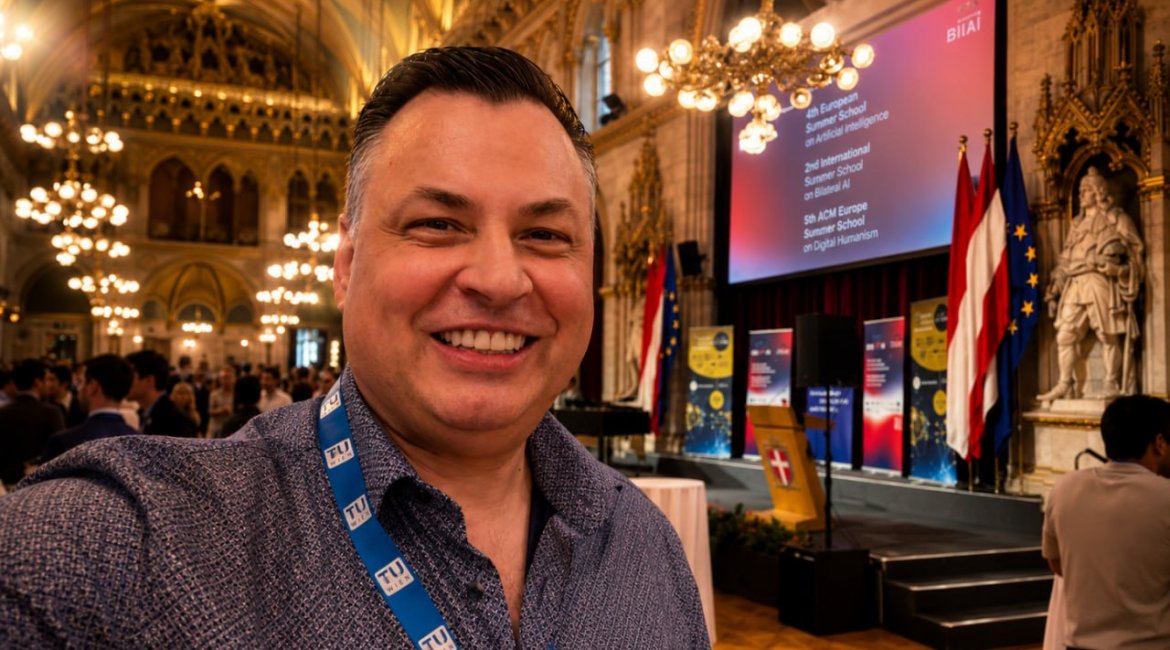
This time I’m attending the joint Digital Humanism Summer School and ESSAI (European Summer School on Artificial Intelligence)—the largest summer school on Artificial Intelligence in Europe—hosted by TU Wien (Vienna University of Technology), one of Europe’s oldest and most respected technical universities.
The school has brought together more than 400 researchers, engineers, philosophers, lawyers, AI ethics experts, and representatives from academia, industry, and public institutions from around the world.
During the first few days, we’ve already explored topics such as:
• the future of Artificial Intelligence and Digital Humanism;
• Large Language Models (LLMs) and Neuro-Symbolic AI;
• AI’s impact on democracy, elections, and society;
• music, culture, and copyright in the age of AI;
• robotics, drones, and embodied (physical) AI;
• digital sovereignty, cybersecurity, and AI governance.
The very first lecture sparked a lively debate. One of the founders of the Digital Humanism movement argued that the growing concentration of power in the hands of a few major technology companies poses a serious challenge to democracy and that the influence of Big Tech should be significantly limited.
One of the highlights so far was our visit to the Austrian Parliament, where, together with representatives of the European Commission, we worked on developing a vision for Europe in 2040 in the age of robotics and embodied AI. Our discussions went far beyond future technologies—we also explored which uniquely human qualities should never be delegated to machines.
The day concluded with a formal reception at Vienna City Hall (Rathaus), where conversations with researchers and experts continued in a much more relaxed atmosphere.
Several exciting days still lie ahead, and I’ll continue sharing the most thought-provoking ideas and discoveries along the way.
Now I’d like to ask you a question.
If, in fifteen years, robots can drive our cars, treat patients, teach children, compose music, write software, and perform most intellectual work better than humans…
What should remain exclusively human?
Which abilities, decisions, or areas of life should we never delegate to Artificial Intelligence?
📱 Mykola Latansky. Subscribe!
Leave a reply