
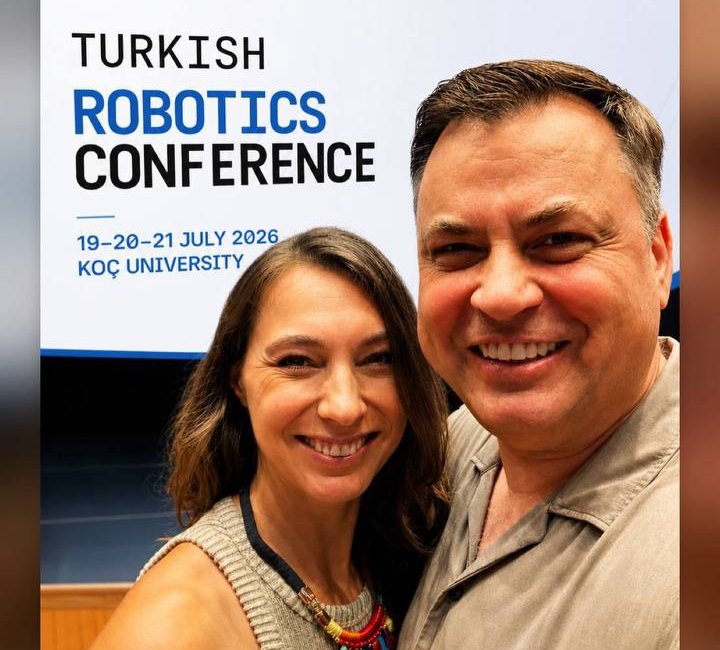
To be honest, this happened quite unexpectedly. Yet it was in Vienna that I found myself seriously reflecting on a question that had long been on my mind:
Why is humanity so determined to build humanoid robots?
The answer turned out to be remarkably simple.
Because virtually the entire infrastructure of our civilization has been designed for human beings. Staircases. Doors. Elevators. Cars. Tools. Workplaces. Billions of objects in our environment are built around the human body. It is therefore far more practical to create robots that fit into the world we have already built than to redesign the world for an entirely different type of machine.
And then, the very first presentation at the conference completely changed the way I think about the human body.
Of course, we all know that our bodies consist of muscles, bones, and joints. But I had never really considered that the human body contains around 650 muscles, with roughly 200–250 being actively engaged in our everyday movements. Nor had I appreciated that muscles never “push.” They only contract, generating pulling forces across our joints. Even the simplest human movements are far more sophisticated and elegant than they appear at first glance.
Today, millions of people are fully immersed in the world of generative AI—learning how to write better prompts, choosing the best models, and experimenting with the latest applications.
But while most people remain focused on software intelligence, the most visionary researchers and the world’s leading technology companies are already taking the next step:
They are giving artificial intelligence a physical body.
Humanoid robots.
That is exactly why we are here.
To understand not only what is happening today, but what will shape tomorrow. To ask deeper questions about the future of Human–Robot Interaction, about human nature, responsibility, and the role of human beings in a world where intelligence no longer exists only in software, but also has a physical presence.
The most fascinating part is that whenever I tell people that the next major technological breakthrough will be the widespread presence of humanoid robots—in our streets, hospitals, offices, hotels, airports, and public institutions—most still see it as distant science fiction.
Yet being here makes one thing abundantly clear:
The future has already begun.
The development of humanoid robotics is accelerating at an exponential pace.
If yesterday we worried that artificial intelligence might replace us as knowledge workers, tomorrow we will be adapting to a world in which that same intelligence has hands, legs, mobility, the ability to manipulate physical objects, and the capacity to work alongside us in the real world.
This conference has brought together some of the world’s leading minds in robotics from Türkiye, Germany, the United Kingdom, the United States, Italy, the Netherlands, Japan, and many other countries, uniting researchers, engineers, industry leaders, and entrepreneurs to discuss the future of robotics.
What are your thoughts?
Leave a reply