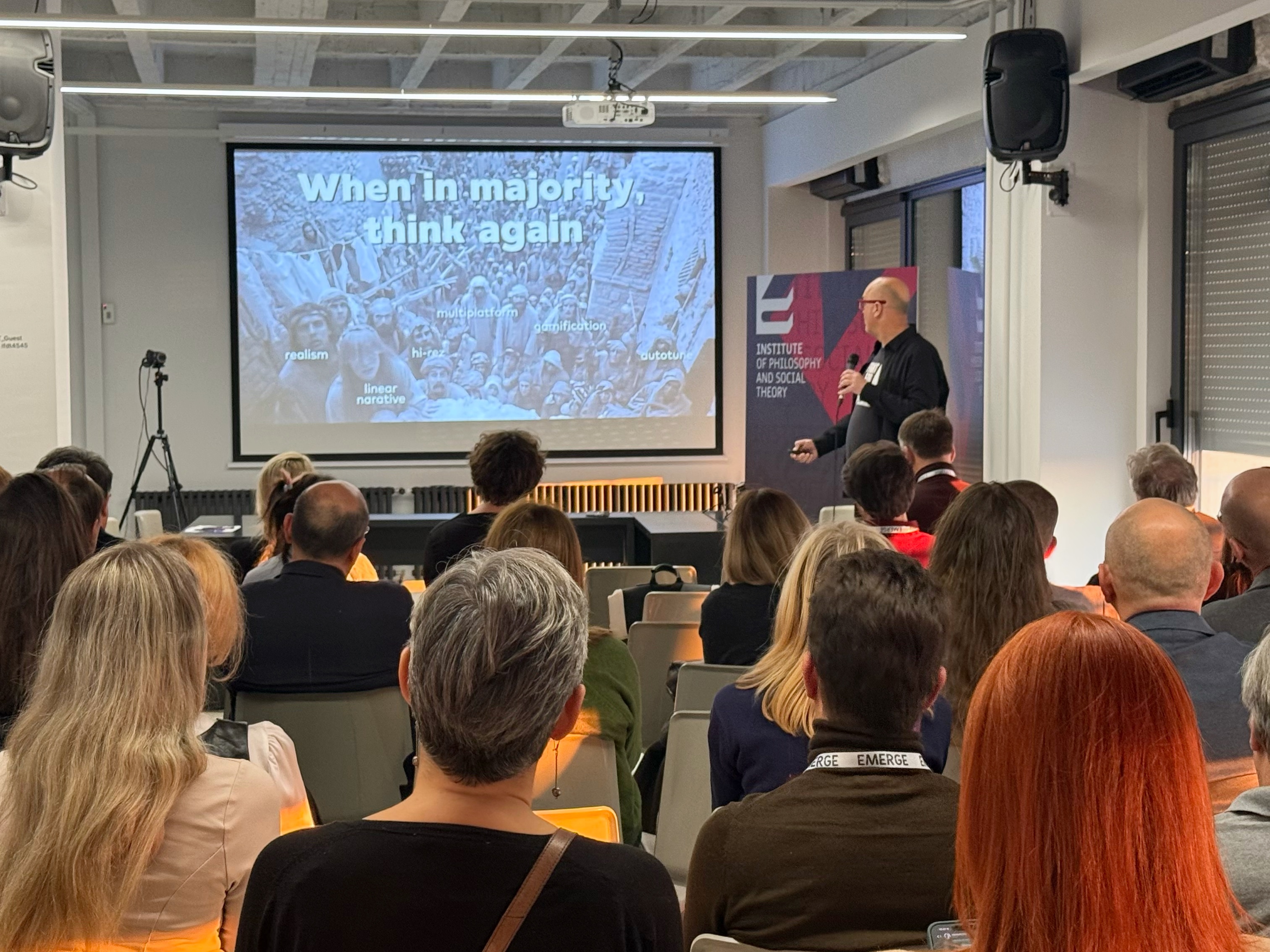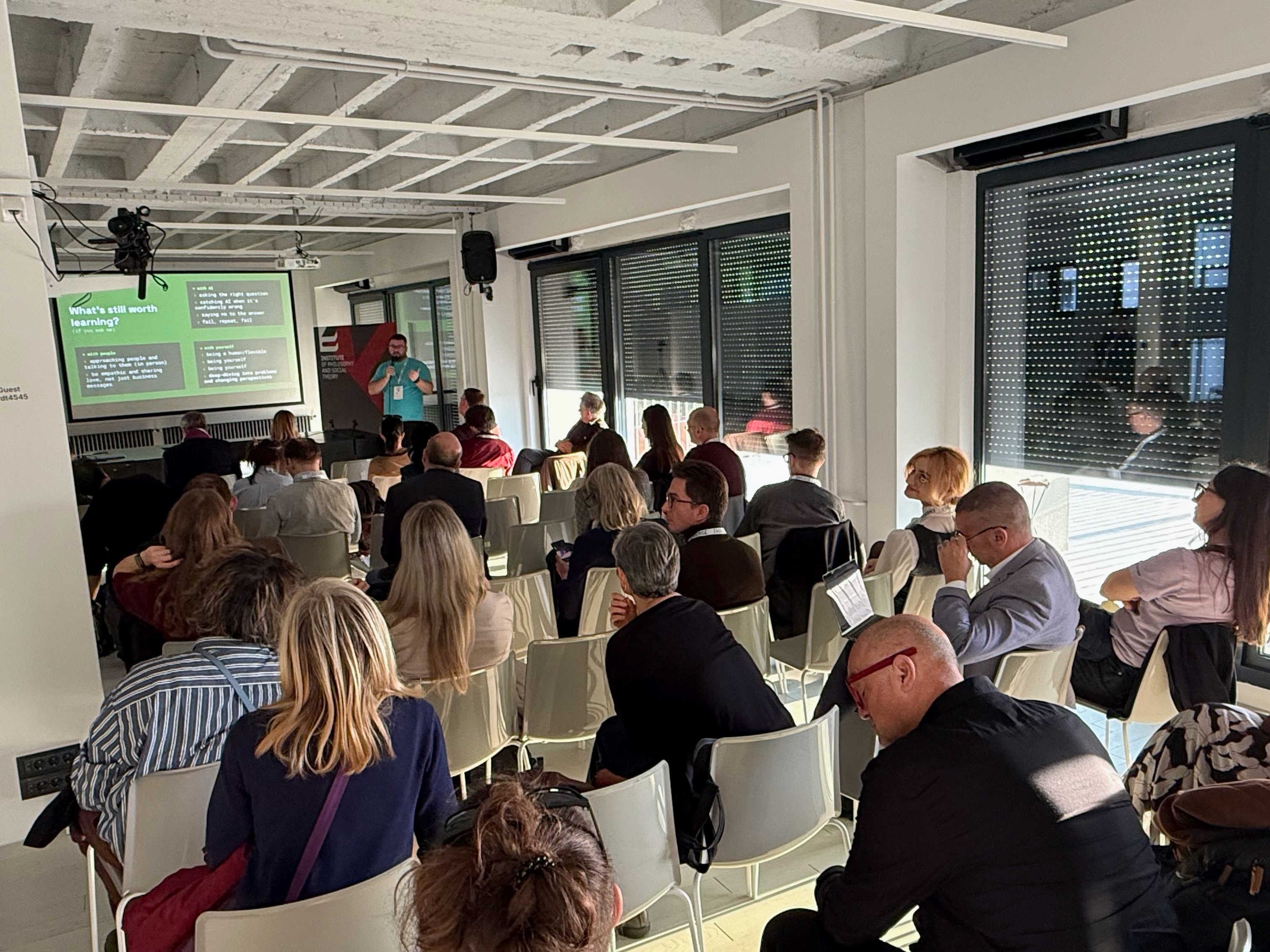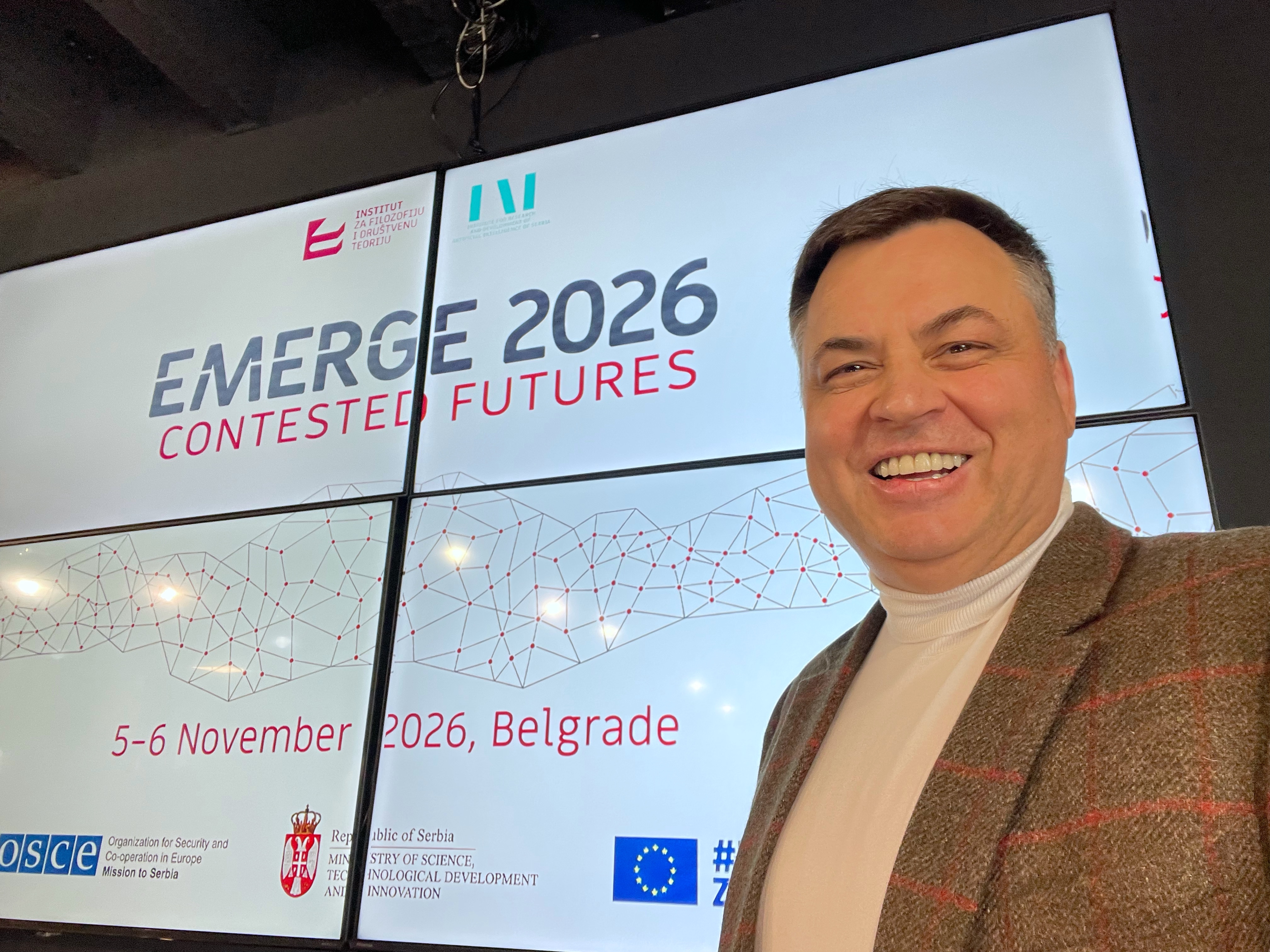
On November 5–6, 2026, I took part in EMERGE 2026: Contested Futures in Belgrade, organized by the University of Belgrade’s Institute for Philosophy and Social Theory. I came away with five ideas that impressed me and five I’d like to challenge.
The first five.
1. One speaker proposed moving toward the integration of humans and AI, allowing us to evolve together. I’ve been thinking along these lines for a long time through the concept of augmented agency — expanding our capacity to act. Humans could extend their abilities, while AI could find new ways to act in the world through us. I think this is where we’re heading.
2. A talk on Latin America described artists who now use AI to do things they previously needed friends to help with. Building a website, for example. We often ask, “What will AI take away from us?” But someone who previously had limited opportunities asks, “What can I do now?” And their possibilities grow.
3. AI makes a mistake — we clarify. It doesn’t understand — we explain it differently. Sometimes we even apologize: “I didn’t phrase that very well.” One speaker invited us to look more closely at this behavior. We contribute a great deal of intelligence and patience to making the conversation work. I do this all the time. I suspect many of you do too.
4. A project to create a digital twin of a hospital revealed how much depends on informal cooperation among staff. Who helped whom, who worked something out with a colleague, who offered support. Try putting all that into an algorithm! You can describe every responsibility and measure how long each task takes — and still miss what makes the hospital work.
5. One speaker had planned to demonstrate AI’s limitations using a task he’d been working on for a long time. But the day before the conference, another attempt unexpectedly produced a result that astonished him. And he told us about it on stage. Imagine: your talk is ready, your arguments are in place, and suddenly you have to rethink your conclusion. With AI, I suspect we’ll be doing this regularly.
Now for five things I disagree with or have doubts about.
6. We heard about a three-dimensional projection of a four-dimensional object in virtual reality. But how far does such a projection really take us toward grasping the fourth dimension? Creating a mathematical representation and directly perceiving what it represents are different things. What exactly did we see? And what can we reasonably claim on that basis?
7. A system was presented in which AI generates scenarios for the future of AI. The authors were clear: these were possibilities, not predictions. Still, how much new knowledge does this actually produce? AI learns from human texts. Could it simply be returning our own fears and expectations to us in a more convincing package? Nobody knows where all this is going.
8. We heard the argument that a superintelligence developing independently would seek to control humanity. Why? Humans have pursued dominance — does that mean any more advanced intelligence would want the same? We don’t yet know what it will be like, but we’re already assigning it our own motives. The idea of humans and AI evolving together makes sense to me. The inevitability of a struggle for power does not.
9. An artist presented a dictionary of invented words that AI supposedly cannot understand. But I wouldn’t understand an unfamiliar word without an explanation either! Let’s provide context, explain the meaning, and see whether AI can use it correctly in a new situation. Then we can draw conclusions about the limits of its understanding.
10. I disagree with doubts about AI’s value as an intellectual sparring partner. Let it find contradictions in my reasoning, demand justification, and offer strong objections. That’s an excellent opportunity to sharpen my thinking. Provided, of course, that I’m willing to think and have my ideas challenged. Having my views confirmed feels much nicer, but does me less good.
How much more capable can we become if we learn to think and act alongside AI? That’s the question I took to Belgrade. I came back with even more.
Photos from Belgrade