
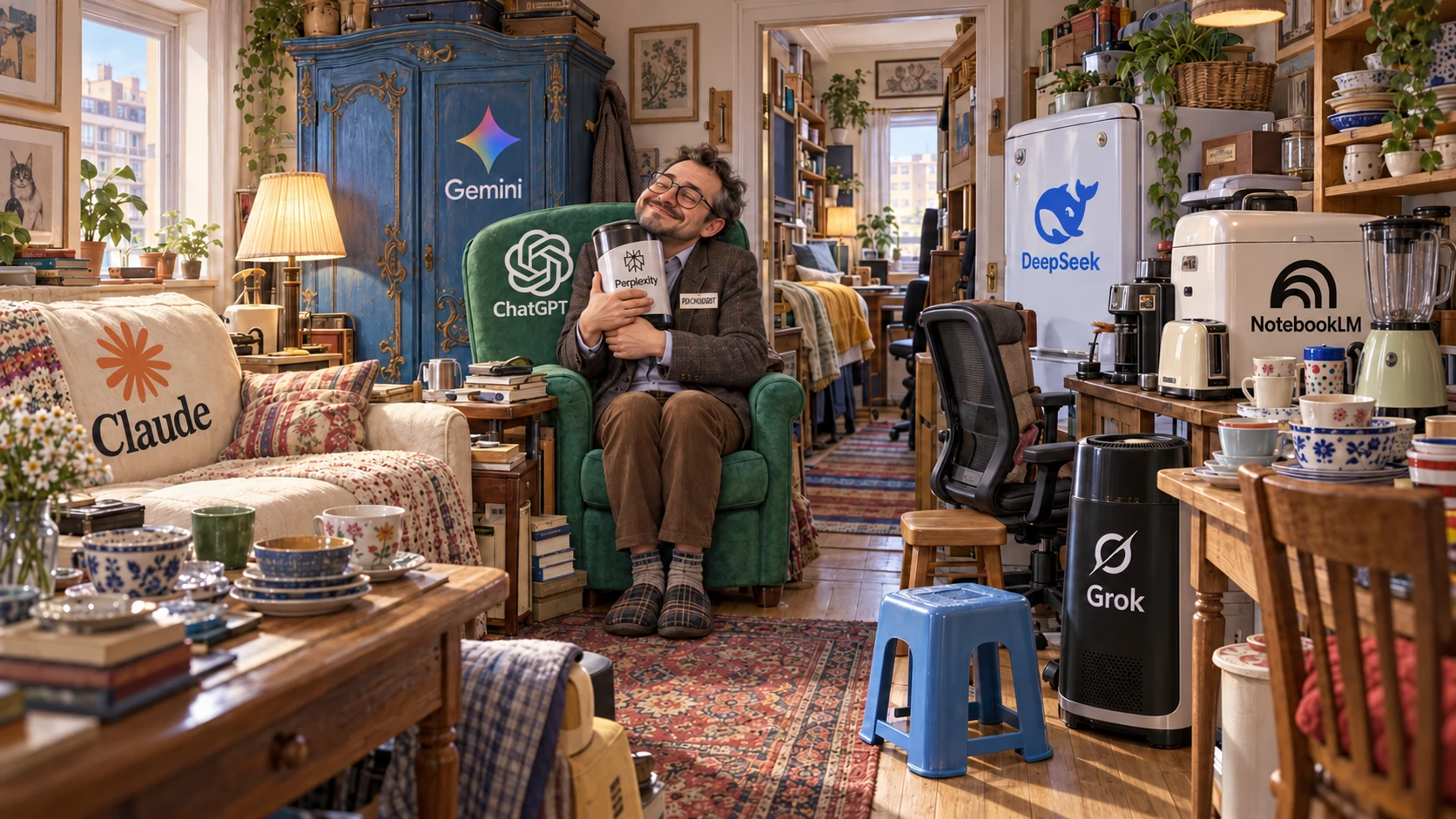
The other day, I attended a webinar for psychologists on using artificial intelligence in their practice. As I listened, I kept picturing the Airbnb apartment we stayed in this summer in Bosnia, when we went to see the local pyramid.
That apartment reminded me of the way people are grabbing at AI right now: collect more, learn more. One more tool. One more webinar. Another hundred prompts — just in case.
The owner seemed to have brought back everything people in Germany no longer wanted. Furniture in completely different styles. A few dishes from one set, a few from another. Appliances that took up space but often served no useful purpose.
It all seemed to follow one rule: if you can get it, take it. Whether any of it worked together, or made the apartment comfortable to live in, apparently wasn’t part of the equation.
Plenty of stuff. Very little comfort.
And now I’m seeing something similar happen with AI.
ChatGPT, Gemini, Claude, Grok… Try this. Master that. Sign up for another webinar. More, more, more.
But what, exactly, is it all for?
Without an answer, even excellent tools become like that furniture. Each piece might be useful on its own. Put them all together, and you have an apartment so cluttered you can barely move.
Except now, we’re cluttering our attention, our time, and our lives.
And we may not even notice. Learning something new is exciting. Watch a webinar, try a tool — it feels like you’ve made progress. Yet the task you actually needed to tackle is still sitting there, untouched.
And now you have even less time for it.
I use AI myself, and I see enormous value in it. But the number of tools keeps growing, while the number of hours in our day stays the same.
So the good old fundamentals still matter: know clearly where you want to go. Develop a strategy. Turn it into concrete steps. Choose the tools that support those steps. And take consistent action.
Otherwise, you can spend your life filling it with new possibilities — without ever putting them to use.
Do you know exactly what you want to achieve five years from now? Do you have a clear idea of how you’ll get there? Do you have a plan for the next 90 days that guides your choice of AI tools?
Or are you frantically trying to keep up, try everything, and master it all — only to feel more exhausted and empty, instead of fulfilled by growth and progress?